Choosing the wrong aluminium grade for your application can cost you time, money, and project quality. This guide breaks down everything you need to know — grades, applications, buying tips, and common pitfalls — so you get it right the first time.
Picture this: a manufacturing unit orders a bulk lot of aluminium sheets, only to discover halfway through production that the material is too soft for their structural requirement. The entire batch has to be replaced. A costly mistake that happens more often than you’d think.
Whether you’re building roofing panels, fabricating automotive parts, or setting up industrial storage, aluminium sheets and coils are among the most versatile materials available. But “aluminium” isn’t a single product — it comes in dozens of alloy grades, tempers, finishes, and thicknesses, each designed for very specific purposes.
At Surender Kumar & Co., a trusted Aluminium Sheets and Coils Supplier with years of industrial experience, we’ve seen the difference the right product makes. This guide is our way of sharing that knowledge with you — no jargon, just clarity.
What Are Aluminium Sheets and Coils, Really?
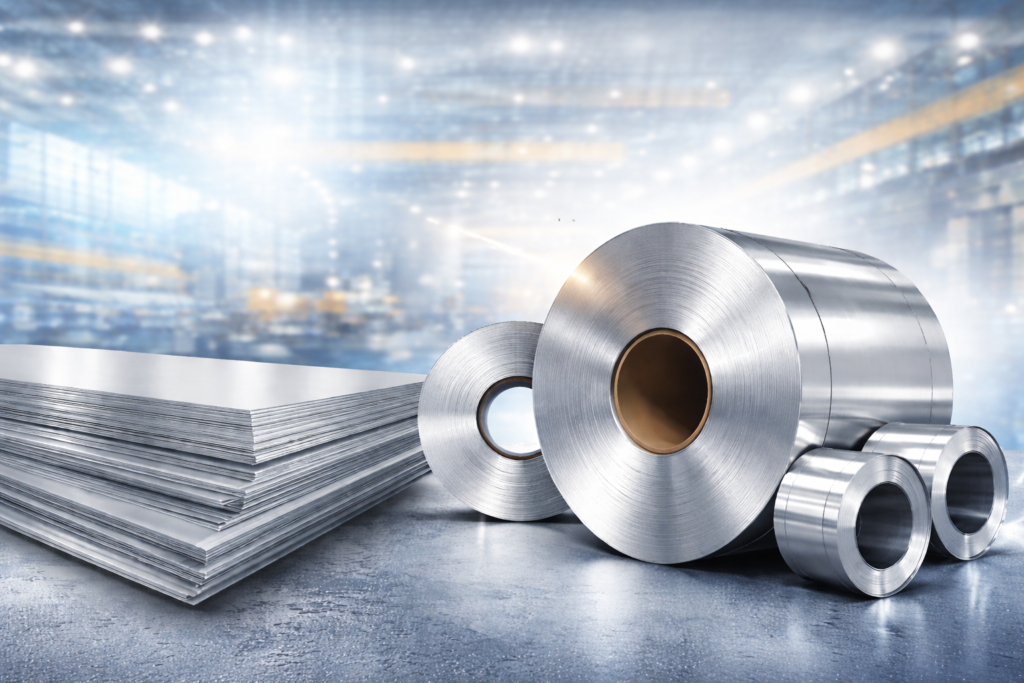
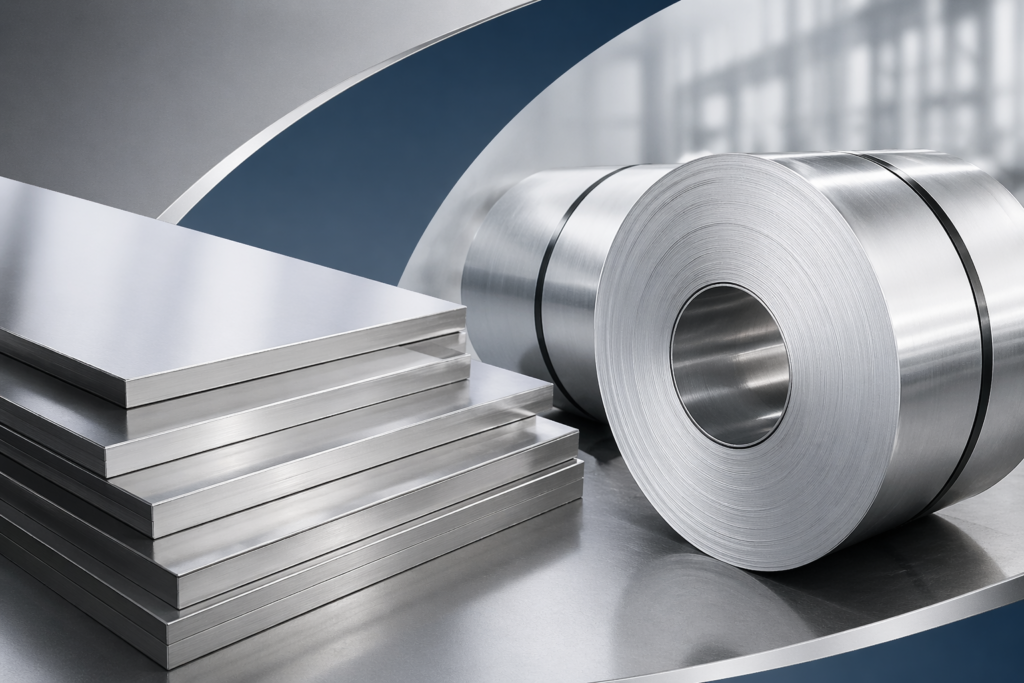
Aluminium sheets are flat, rolled pieces of aluminium alloy — think of them like large, precise metal panels. Coils, on the other hand, are continuous lengths of aluminium rolled into a cylindrical form for easy transport and uncoiling during fabrication. Both forms come from the same base material but serve different production workflows.
Sheets are ideal when you need specific-size panels for roofing, cladding, or precision-cut parts. Coils are preferred in high-volume operations — like automotive stamping, HVAC fabrication, or roll-forming — where material is fed continuously into machines.
Aluminium Sheets vs. Aluminium Coils — Quick Comparison
| Feature | Aluminium Sheets | Aluminium Coils |
| Form | Flat, cut-to-size panels | Continuous rolled strips |
| Typical Thickness | 0.5 mm – 6 mm | 0.2 mm – 3 mm |
| Best For | Cladding, roofing, fabrication | Roll-forming, stamping, HVAC |
| Storage | Flat stacking | Spool/reel format |
| Minimum Order | Smaller quantities possible | Usually higher MOQ |
| Surface Finish Options | Mill, anodised, coated, painted | Mill, pre-painted, lacquered |
| Waste Generation | More offcuts | Less material waste |
Understanding Aluminium Alloy Grades for Industrial Use
This is where most buyers get confused — and understandably so. The alloy grade tells you everything about how the material will perform. Let’s break down the most commonly used grades in industrial applications.
Common Aluminium Grades and Their Industrial Applications
| Grade | Key Properties | Best Industrial Use | Weldability |
| 1050 / 1100 | Pure aluminium, soft, highly formable | Chemical tanks, food packaging, reflectors | Excellent |
| 3003 | Good formability, moderate strength | HVAC, storage tanks, pressure vessels | Excellent |
| 5052 | High fatigue strength, marine-grade | Marine components, fuel tanks, electronics | Good |
| 6061 | Structural grade, heat-treatable | Structural parts, automotive, aerospace | Good |
| 8011 | Thin gauge, food-safe | Aluminium foil, pharmaceutical packaging | Fair |
| 5754 | Corrosion resistant, lightweight | Transportation, vehicle bodywork | Good |
If you’re unsure which grade fits your project, a reliable aluminium sheets and coils supplier like Surender Kumar & Co. will always help you narrow it down based on your end application, load requirements, and finishing needs.
Key Benefits of Using Aluminium in Industrial Applications
Aluminium has been the material of choice across industries for decades — and for good reason. Here’s why engineers, architects, and manufacturers keep coming back to it:
- Exceptional Strength-to-Weight Ratio: Aluminium is roughly one-third the weight of steel, yet certain alloys match steel’s strength in structural applications. This makes it indispensable in transportation and aerospace.
- Natural Corrosion Resistance: Aluminium forms a protective oxide layer naturally, making it ideal for outdoor, marine, and chemical environments without needing extra coating.
- Excellent Thermal and Electrical Conductivity: In HVAC, heat exchangers, and electrical enclosures, aluminium’s conductivity is a significant advantage.
- High Recyclability: About 75% of all aluminium ever produced is still in active use today. Recycling aluminium uses just 5% of the energy required to produce primary aluminium.
- Ease of Fabrication: Aluminium cuts, bends, rolls, welds, and machines cleanly — reducing production time and tool wear.
- Versatile Surface Finishing: From anodising and powder coating to mirror polishing and stucco embossing, aluminium adapts to almost any aesthetic or functional requirement.
How to Choose the Right Aluminium Sheet or Coil: A Step-by-Step Guide
Making the right purchase doesn’t have to be overwhelming. Follow these steps and you’ll narrow down your options quickly.
Step-by-Step Buying Process for Aluminium Sheets & Coils
| Step | What to Do | Why It Matters |
| Step 1 | Define your application clearly | Grade selection depends entirely on end use |
| Step 2 | Determine required thickness and width | Ensures structural and dimensional fit |
| Step 3 | Choose the right alloy grade | Determines strength, formability, corrosion resistance |
| Step 4 | Select the temper (H14, H24, T6, etc.) | Defines hardness and workability level |
| Step 5 | Decide on surface finish | Affects aesthetics, durability, and further processing |
| Step 6 | Confirm certifications required | ISO, BIS, or industry-specific standards may be mandatory |
| Step 7 | Request material test certificates (MTC) | Validates chemical composition and mechanical properties |
| Step 8 | Compare suppliers on quality + delivery | Price alone isn’t a reliable measure of value |
Tips and Best Practices When Buying Aluminium Sheets and Coils
Pro Tip from Surender Kumar & Co.: Always ask for a Material Test Certificate (MTC) with every order. It’s your assurance that the product meets the claimed alloy grade and mechanical standards.
- Don’t over-specify: If 3003 grade works for your application, don’t pay for 6061. Over-engineering costs money without adding value.
- Order with tolerances in mind: Industry standards allow slight variations in thickness and width. Ensure your design accounts for these tolerances rather than assuming zero deviation.
- Check the temper designation carefully: H14 and H24 may look similar but have different strength levels. Confusing them in a structural application is a serious risk.
- Source from verified suppliers: As an established aluminium sheets and coils supplier, we emphasize traceability. Know where your material comes from and verify it against standards.
- Protect stored material from moisture: Even corrosion-resistant aluminium can develop white oxidation spots (white rust) if stored in damp, poorly ventilated spaces. Store flat sheets on pallets with desiccants in humid environments.
- Pre-lubricate coils before forming: When feeding coils into roll-forming or stamping equipment, use appropriate lubricants to reduce surface scratching and extend tool life.
Common Mistakes to Avoid When Purchasing Aluminium
Do’s and Don’ts — Aluminium Purchasing Checklist
| Category | Do This | Avoid This |
| Grade Selection | Match grade to application requirements | Buying any available grade to cut costs |
| Certification | Always request MTC / mill certificates | Accepting material without documentation |
| Thickness | Verify actual thickness with gauge tool | Trusting packaging labels blindly |
| Surface Finish | Specify finish type (mill/anodised/coated) | Leaving finish unspecified in the PO |
| Storage | Store in dry, ventilated areas on pallets | Direct floor contact or outdoor storage |
| Supplier | Choose suppliers with industry track record | Choosing purely on lowest price |
| Order Quantity | Order slightly extra for offcuts and trials | Ordering exact quantity with no buffer |
Industrial Applications Where Aluminium Sheets and Coils Shine
Still wondering where exactly these materials are used? Here’s a snapshot across sectors:
Industry-Wise Application Reference Guide
| Industry | Common Application | Recommended Grade |
| Construction | Roofing, cladding, false ceilings | 3003, 5052 |
| Automotive | Body panels, heat shields, structural parts | 5754, 6061 |
| HVAC | Air conditioning fins, ductwork, coils | 3003, 1100 |
| Packaging | Blister packs, foil laminates, caps | 8011, 1050 |
| Marine | Hull plating, deck panels, fittings | 5052, 5083 |
| Electrical | Bus bars, transformer windings, enclosures | 1350, 6061 |
| Food Processing | Conveyor belts, storage tanks, trays | 1100, 3003 |
| Aerospace | Structural frames, skin panels | 6061, 2024 |
Frequently Asked Questions (FAQ)
Q1. What is the difference between aluminium sheets and aluminium coils?
Aluminium sheets are flat, pre-cut panels available in standard or custom sizes. Coils are continuous rolls of aluminium strip used in high-volume manufacturing processes like roll-forming and stamping. Sheets suit smaller or custom jobs; coils are better for automated, continuous production.
Q2. Which aluminium grade is best for roofing applications?
For roofing and cladding, Grade 3003 and 5052 are most commonly used. Grade 3003 offers good formability and moderate corrosion resistance, while Grade 5052 adds higher fatigue strength — useful for coastal or high-wind environments.
Q3. What does the temper designation mean on an aluminium sheet?
The temper tells you the material’s strength and hardness level, achieved through work hardening or heat treatment. For example, H14 means half-hard (work-hardened), while T6 means solution heat-treated and artificially aged. The temper directly affects formability and structural performance.
Q4. Is aluminium better than steel for industrial use?
It depends on the application. Aluminium wins on weight, corrosion resistance, and conductivity. Steel is preferred when higher tensile strength or lower cost per unit weight matters. Many modern industries use both — selecting based on specific performance requirements rather than treating one as universally better.
Q5. How do I verify the quality of aluminium sheets I receive?
Request a Material Test Certificate (MTC) from your supplier. It should specify alloy grade, temper, chemical composition, and mechanical properties (tensile strength, yield strength, elongation). You can also verify thickness using a digital calliper or ultrasonic gauge upon receipt.
Q6. Why should I choose Surender Kumar & Co. as my aluminium sheets and coils supplier?
Surender Kumar & Co. offers a wide range of aluminium grades, verified quality with proper certifications, competitive pricing, and end-to-end support from grade selection to delivery. Our decades of experience in the industrial materials space mean you’re not just buying metal — you’re getting reliable expertise.
Conclusion: The Right Aluminium Partner Makes All the Difference
Aluminium sheets and coils are not a commodity you should pick off a shelf without thought. The grade, temper, finish, and thickness all play a critical role in how your final product performs — whether you’re building a rooftop, fabricating automotive components, or setting up an HVAC system.
The good news? You don’t have to figure it all out alone. A knowledgeable aluminium sheets and coils supplier will help you identify the right specification for your exact application, ensure quality through proper documentation, and deliver consistently — batch after batch.
At Surender Kumar & Co., we believe in being more than just a supplier. We’re a partner in your production process. Whether you’re a first-time buyer or a seasoned procurement professional, we’re here to make the process smoother, smarter, and more cost-effective.
Ready to source high-quality aluminium sheets and coils?
Get in touch with Surender Kumar & Co. today for expert guidance, competitive quotes, and reliable delivery. Let’s build something strong together.
Contact us for product specifications, bulk pricing, and custom requirements.